
I’ve decided that the older I get, the more like my father I become. When I was little, any question about faith I had for my dad was answered by the many books he would read, followed up by the books or materials referenced in those books. We would sit together and  discuss all aspects of life and faith, never being told to believe something just because he said so. My curious mind was always encouraged and valued. I have always enjoyed the moment when something clicks in my brain and enjoy the process of learning and thinking through complicated concepts. I even have that clicking moment when learning new music. There is a point in the opera learning process when the piece is finally organized in my brain. It is then I know I am only a few short steps away from memorization. It’s a great moment!
I remember my dad always finding ways to create a safe place to learn and question faith for others as well. Since he had done his own research to find his faith, he always wanted to make sure this opportunity was available to others. He has spent over 15 years meeting with a group of people of different backgrounds and beliefs to explore Christianity. He would come with resources and, in kind, read anything the group brought to him to consider as well. I attended many of these meetings when I was in high school, even though the rest of the group was three times my age. I guess you could say the geekiness set on at a very young age and apparently never left.
My book collection and list of podcasts today are evidence of a continued fascination with understanding my faith from all angles. I listen to an amazing podcast called Unbelievable? from England that hosts debates between Christians and non-Christians, sermons by numerous pastors from around the country, NPR’s Intelligence Squared and a great podcast called The Friendly Atheist. My dad’s collection is filled with books by all perspectives. I remember him saying “you can’t just read the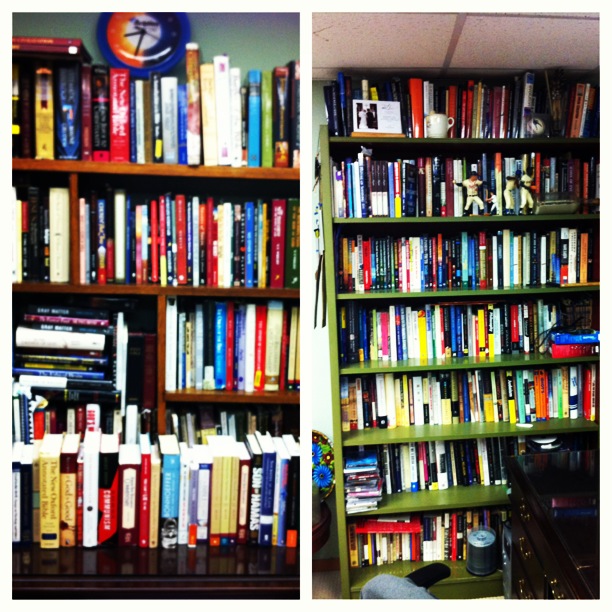 people who agree with you.” I love this about him. He not only instilled in me a love of researching and searching for myself, but also a love of conversing with and listening to people who don’t agree with my conclusions.
I hadn’t realized until recently how much of an impact that had on my worldview today. I completely and utterly believe that the biggest problem in our country today is our inability to LISTEN to people who are different from us. I have a large contingency of Facebook friends from small town South Dakota and another group of big city singers. Every time an election comes around or major event in the news, I see these two groups post and rally around their friends, in complete shock that anyone could disagree with them, which usually leads to a host of comments agreeing with their position. Of course, these two groups are usually on opposite sides of the fence. And every once and a while, a rogue from the other side will comment with a disagreement, often leading to a vicious back and forth of arguments and accusations. I stay out of these arguments and find myself wishing the individuals could converse, in person, about how they came to their conclusions. It’s easy to rant at each other through a computer screen, but much harder (and more valuable), to have those discussions face to face. This, however, means you have to have people of differing opinions in your life and a place and willingness to engage in difficult conversations. While I don’t agree with all of the people in my life, I love and respect people on every side of every issue.
My soapbox platform of productive, lively debates has culminated in the formation of a Pub Theology group. Originally, I wasn’t sure in which direction the group would go. I had previously started a group to discuss writings of C.S. Lewis (Yep.. major geek alert, but you should know that I’m pretty sure Lewis was my soulmate and it is devastating that he is  dead), but thought this one might have a broader scope of topics and participants. It has become an amazing, life-giving group. We are a mixture of Christians, Atheists, Secular Humanists, Agnostics, and others, coming together to discuss relevant issues. We have discussed topics from “Why are Millennials leaving the church?” to “Art and Censorship,” “Confronting Radicalism” to “Separation of Church and State.” At a recent brainstorming session, we also decided to delve into more incendiary topics, since the core of the group knows each other well enough and has formed comfortable, respectful friendships through our discussions. We feel ready to discuss hot topics and I can’t wait!
This group has become a micro-example of what I wish our world could do. We don’t have to pretend that we agree, or that everyone can be right, or that any issue is completely black or white. We don’t demonize those who don’t believe what we do and we strive to genuinely understand the other perspective. Granted, I acknowledge that we happen to have an exceptional group of individuals who joined the group because they want to meet people who think differently than they do, but shouldn’t we all have that goal? Isn’t life more interesting when we are able to explore this beautifully diverse world and appreciate the differences? Can’t we respect that people have come to other conclusions than we have, even if we think theirs is wrong? Can’t we acknowledge that if we EVER have changed our mind, or factored in new information to a belief, we were wrong ourselves? And there are probably a whole host of issues we will change our minds on in a good 10 to 20 years, and that’s ok. We spend our life journeying through trial and error, assumptions and proof, theoretical and actual. We should never assume others aren’t on a journey as well.
I feel like we function out of a belief that we can’t respect someone we disagree with, even though we find a plethora of disagreements with every loved one in our life. The difference is that we know and understand them, regardless of that issue or are actively working through it in love. It’s easy to hate, disrespect, and be offended by the beliefs of someone who we don’t know, someone who may only exist, to us, in cyberspace or on the TV screen. But If we make the time and the space to get to know people who disagree with us, we can move away from the obsession with polarizing issues and closer to understanding the human beings around us. The more of us willing to risk having uncomfortable conversations and open minds, the more progress can be made and our world can move closer to functioning out of love and respect, rather than fear.
Ok.. I’ll get off my soapbox now. Thanks for reading. 🙂


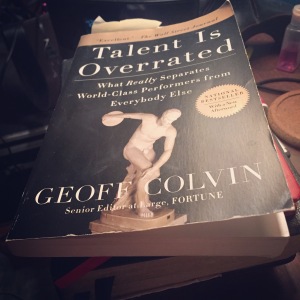 lots of effort to achieve your goals. And, in my case, one area emerges as what you love working at and it becomes the thing in which you strive for excellence. A similar theory is espoused in a great book called “Talent is overrated.” It’s the idea that people who are truly great at what they do are not so only because of natural ability, but because of the type of focused work they put into their craft. Mozart was brilliant because of the musical household and fastidious work regiment his family placed on him at a young age. Tiger Woods was a brilliant golfer because he spent his whole childhood practicing. Natural ability absolutely exists, but if you don’t learn to work, you can never really reach your potential.


 fabulous.common